Printables › Solar system
Solar system puzzle packs to print
11 free printable solar system puzzle packs for grades 3 to 6, as PDFs. No account, no card: open one and print it, for one student or a whole class.
- One-page lesson with key words
- Word search
- Crossword with clues
- Math code puzzle
- Maze
- Answer key for the crossword and the code
Start with What Is the Solar System?, then give each group a different planet, Moon or comet pack and have them share one thing they learned. Phases of the Moon fits a month of looking up at night.
The 11 packs
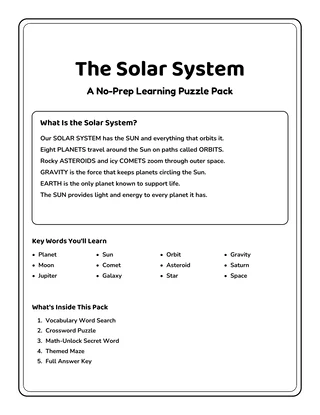
The Solar System
What Is the Solar System?
Our SOLAR SYSTEM has the SUN and everything that orbits it. Eight PLANETS travel around the Sun on paths called ORBITS. Rocky ASTEROIDS and icy COMETS zoom through outer space. GRAVITY is the force that keeps planets circling the Sun. EARTH is the only planet known to support life. The SUN provides light and energy to every planet it has.
Key words: Planet, Sun, Orbit, Gravity, Moon, Comet, Asteroid, Saturn, Jupiter, Galaxy, Star, Space.
Open the PDF (6 pages)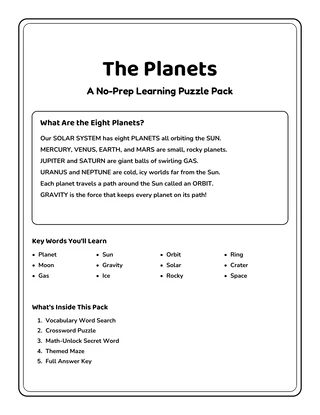
The Planets
What Are the Eight Planets?
Our SOLAR SYSTEM has eight PLANETS all orbiting the SUN. MERCURY, VENUS, EARTH, and MARS are small, rocky planets. JUPITER and SATURN are giant balls of swirling GAS. URANUS and NEPTUNE are cold, icy worlds far from the Sun. Each planet travels a path around the Sun called an ORBIT. GRAVITY is the force that keeps every planet on its path!
Key words: Planet, Sun, Orbit, Ring, Moon, Gravity, Solar, Crater, Gas, Ice, Rocky, Space.
Open the PDF (6 pages)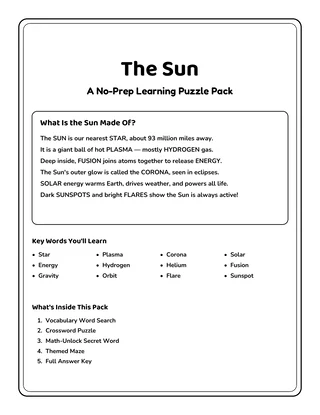
The Sun
What Is the Sun Made Of?
The SUN is our nearest STAR, about 93 million miles away. It is a giant ball of hot PLASMA – mostly HYDROGEN gas. Deep inside, FUSION joins atoms together to release ENERGY. The Sun's outer glow is called the CORONA, seen in eclipses. SOLAR energy warms Earth, drives weather, and powers all life. Dark SUNSPOTS and bright FLARES show the Sun is always active!
Key words: Star, Plasma, Corona, Solar, Energy, Hydrogen, Helium, Fusion, Gravity, Orbit, Flare, Sunspot.
Open the PDF (6 pages)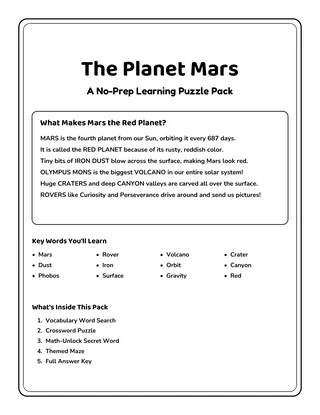
The Planet Mars
What Makes Mars the Red Planet?
MARS is the fourth planet from our Sun, orbiting it every 687 days. It is called the RED PLANET because of its rusty, reddish color. Tiny bits of IRON DUST blow across the surface, making Mars look red. OLYMPUS MONS is the biggest VOLCANO in our entire solar system! Huge CRATERS and deep CANYON valleys are carved all over the surface. ROVERS like Curiosity and Perseverance drive around and send us pictures!
Key words: Mars, Rover, Volcano, Crater, Dust, Iron, Orbit, Canyon, Phobos, Surface, Gravity, Red.
Open the PDF (6 pages)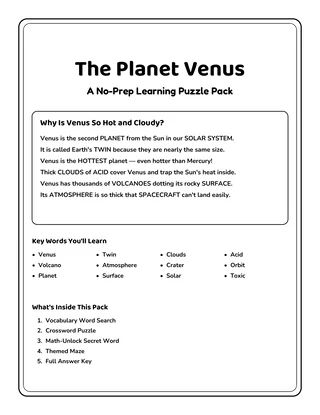
The Planet Venus
Why Is Venus So Hot and Cloudy?
Venus is the second PLANET from the Sun in our SOLAR SYSTEM. It is called Earth's TWIN because they are nearly the same size. Venus is the HOTTEST planet – even hotter than Mercury! Thick CLOUDS of ACID cover Venus and trap the Sun's heat inside. Venus has thousands of VOLCANOES dotting its rocky SURFACE. Its ATMOSPHERE is so thick that SPACECRAFT can't land easily.
Key words: Venus, Twin, Clouds, Acid, Volcano, Atmosphere, Crater, Orbit, Planet, Surface, Solar, Toxic.
Open the PDF (6 pages)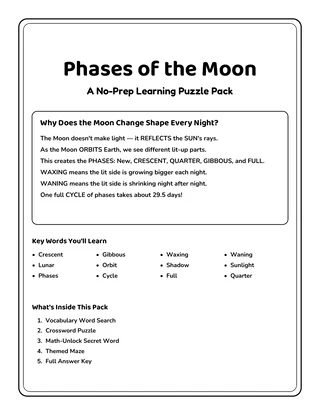
Phases of the Moon
Why Does the Moon Change Shape Every Night?
The Moon doesn't make light – it REFLECTS the SUN's rays. As the Moon ORBITS Earth, we see different lit-up parts. This creates the PHASES: New, CRESCENT, QUARTER, GIBBOUS, and FULL. WAXING means the lit side is growing bigger each night. WANING means the lit side is shrinking night after night. One full CYCLE of phases takes about 29.5 days!
Key words: Crescent, Gibbous, Waxing, Waning, Lunar, Orbit, Shadow, Sunlight, Phases, Cycle, Full, Quarter.
Open the PDF (6 pages)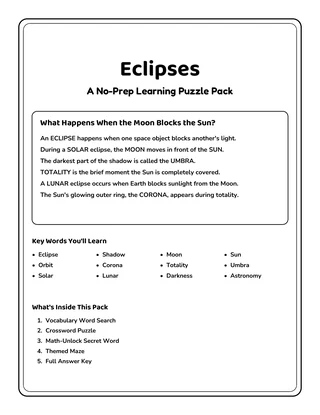
Eclipses
What Happens When the Moon Blocks the Sun?
An ECLIPSE happens when one space object blocks another's light. During a SOLAR eclipse, the MOON moves in front of the SUN. The darkest part of the shadow is called the UMBRA. TOTALITY is the brief moment the Sun is completely covered. A LUNAR eclipse occurs when Earth blocks sunlight from the Moon. The Sun's glowing outer ring, the CORONA, appears during totality.
Key words: Eclipse, Shadow, Moon, Sun, Orbit, Corona, Totality, Umbra, Solar, Lunar, Darkness, Astronomy.
Open the PDF (6 pages)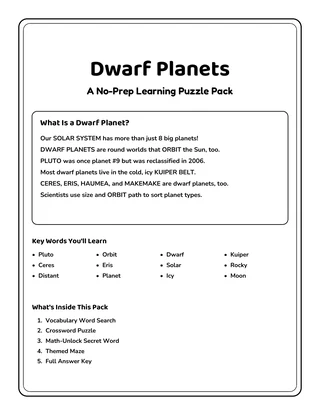
Dwarf Planets
What Is a Dwarf Planet?
Our SOLAR SYSTEM has more than just 8 big planets! DWARF PLANETS are round worlds that ORBIT the Sun, too. PLUTO was once planet #9 but was reclassified in 2006. Most dwarf planets live in the cold, icy KUIPER BELT. CERES, ERIS, HAUMEA, and MAKEMAKE are dwarf planets, too. Scientists use size and ORBIT path to sort planet types.
Key words: Pluto, Orbit, Dwarf, Kuiper, Ceres, Eris, Solar, Rocky, Distant, Planet, Icy, Moon.
Open the PDF (6 pages)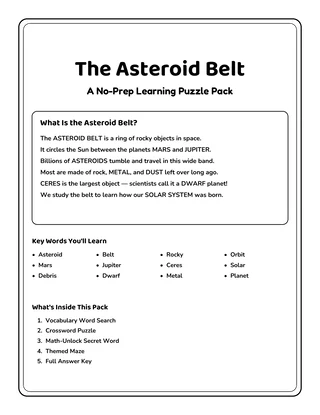
The Asteroid Belt
What Is the Asteroid Belt?
The ASTEROID BELT is a ring of rocky objects in space. It circles the Sun between the planets MARS and JUPITER. Billions of ASTEROIDS tumble and travel in this wide band. Most are made of rock, METAL, and DUST left over long ago. CERES is the largest object – scientists call it a DWARF planet! We study the belt to learn how our SOLAR SYSTEM was born.
Key words: Asteroid, Belt, Rocky, Orbit, Mars, Jupiter, Ceres, Solar, Debris, Dwarf, Metal, Planet.
Open the PDF (6 pages)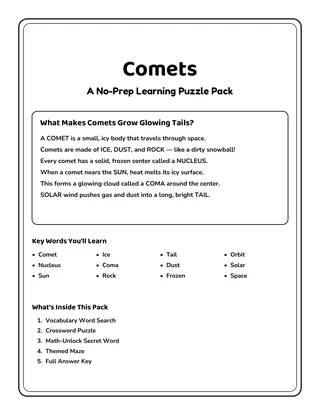
Comets
What Makes Comets Grow Glowing Tails?
A COMET is a small, icy body that travels through space. Comets are made of ICE, DUST, and ROCK – like a dirty snowball! Every comet has a solid, frozen center called a NUCLEUS. When a comet nears the SUN, heat melts its icy surface. This forms a glowing cloud called a COMA around the center. SOLAR wind pushes gas and dust into a long, bright TAIL.
Key words: Comet, Ice, Tail, Orbit, Nucleus, Coma, Dust, Solar, Sun, Rock, Frozen, Space.
Open the PDF (6 pages)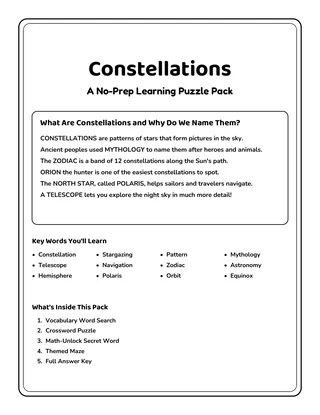
Constellations
What Are Constellations and Why Do We Name Them?
CONSTELLATIONS are patterns of stars that form pictures in the sky. Ancient peoples used MYTHOLOGY to name them after heroes and animals. The ZODIAC is a band of 12 constellations along the Sun's path. ORION the hunter is one of the easiest constellations to spot. The NORTH STAR, called POLARIS, helps sailors and travelers navigate. A TELESCOPE lets you explore the night sky in much more detail!
Key words: Constellation, Stargazing, Pattern, Mythology, Telescope, Navigation, Zodiac, Astronomy, Hemisphere, Polaris, Orbit, Equinox.
Open the PDF (6 pages)Each lesson is shown as it is printed; the words in capitals are the vocabulary. Search the Cargo Bay for more packs like these.
Games on the same topic
- Planet ProbeSolar System game, free
- Gravity GameGravity and Weight game, free
- Photon PhaserLight game, free
Questions
- Are the packs really free to print?
- Yes. Every pack opens as a PDF with no account, no email and no card, for a class or at home.
- What is in a pack?
- Six letter-size pages in black and white: a one-page lesson, a word search, a crossword, a math code puzzle, a maze, and an answer key for the crossword and the code puzzle.
- What grades are they for?
- Grades 3 to 6, roughly ages 8 to 12. The lesson is a short paragraph, so most students can read it on their own.
- Who makes them?
- A small independent studio in Ontario, Canada. They are built with AI and checked before they go up.