Printables › Food chain and ecosystem
Food chain and ecosystem puzzle packs to print
10 free printable food chain and ecosystem puzzle packs for grades 3 to 6, as PDFs. No account, no card: open one and print it, for one student or a whole class.
- One-page lesson with key words
- Word search
- Crossword with clues
- Math code puzzle
- Maze
- Answer key for the crossword and the code
Start with producers and consumers, then food webs. Give half the class the pond and half the savanna, and compare the two webs.
The 10 packs
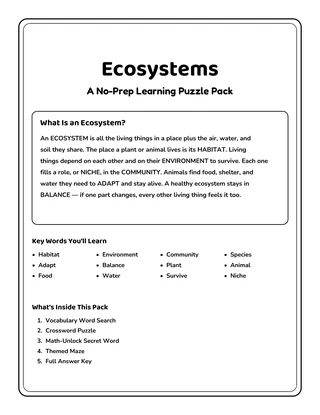
Ecosystems
What Is an Ecosystem?
An ECOSYSTEM is all the living things in a place plus the air, water, and soil they share. The place a plant or animal lives is its HABITAT. Living things depend on each other and on their ENVIRONMENT to survive. Each one fills a role, or NICHE, in the COMMUNITY. Animals find food, shelter, and water they need to ADAPT and stay alive. A healthy ecosystem stays in BALANCE – if one part changes, every other living thing feels it too.
Key words: Habitat, Environment, Community, Species, Adapt, Balance, Plant, Animal, Food, Water, Survive, Niche.
Open the PDF (6 pages)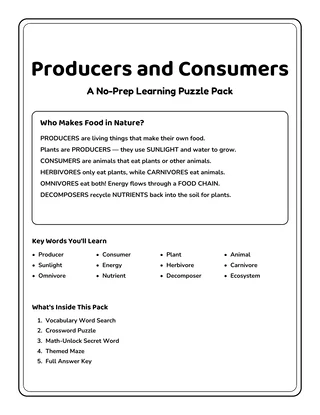
Producers and Consumers
Who Makes Food in Nature?
PRODUCERS are living things that make their own food. Plants are PRODUCERS – they use SUNLIGHT and water to grow. CONSUMERS are animals that eat plants or other animals. HERBIVORES only eat plants, while CARNIVORES eat animals. OMNIVORES eat both! Energy flows through a FOOD CHAIN. DECOMPOSERS recycle NUTRIENTS back into the soil for plants.
Key words: Producer, Consumer, Plant, Animal, Sunlight, Energy, Herbivore, Carnivore, Omnivore, Nutrient, Decomposer, Ecosystem.
Open the PDF (6 pages)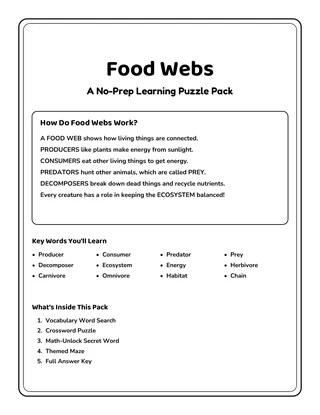
Food Webs
How Do Food Webs Work?
A FOOD WEB shows how living things are connected. PRODUCERS like plants make energy from sunlight. CONSUMERS eat other living things to get energy. PREDATORS hunt other animals, which are called PREY. DECOMPOSERS break down dead things and recycle nutrients. Every creature has a role in keeping the ECOSYSTEM balanced!
Key words: Producer, Consumer, Predator, Prey, Decomposer, Ecosystem, Energy, Herbivore, Carnivore, Omnivore, Habitat, Chain.
Open the PDF (6 pages)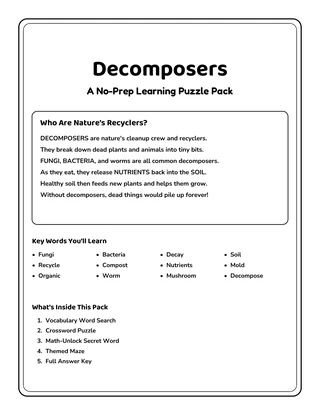
Decomposers
Who Are Nature's Recyclers?
DECOMPOSERS are nature's cleanup crew and recyclers. They break down dead plants and animals into tiny bits. FUNGI, BACTERIA, and worms are all common decomposers. As they eat, they release NUTRIENTS back into the SOIL. Healthy soil then feeds new plants and helps them grow. Without decomposers, dead things would pile up forever!
Key words: Fungi, Bacteria, Decay, Soil, Recycle, Compost, Nutrients, Mold, Organic, Worm, Mushroom, Decompose.
Open the PDF (6 pages)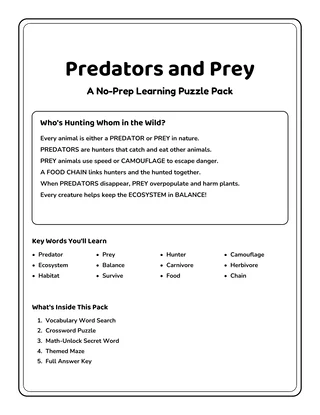
Predators and Prey
Who's Hunting Whom in the Wild?
Every animal is either a PREDATOR or PREY in nature. PREDATORS are hunters that catch and eat other animals. PREY animals use speed or CAMOUFLAGE to escape danger. A FOOD CHAIN links hunters and the hunted together. When PREDATORS disappear, PREY overpopulate and harm plants. Every creature helps keep the ECOSYSTEM in BALANCE!
Key words: Predator, Prey, Hunter, Camouflage, Ecosystem, Balance, Carnivore, Herbivore, Habitat, Survive, Food, Chain.
Open the PDF (6 pages)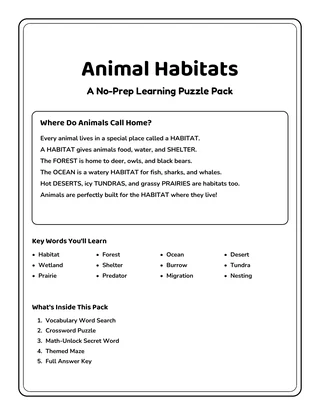
Animal Habitats
Where Do Animals Call Home?
Every animal lives in a special place called a HABITAT. A HABITAT gives animals food, water, and SHELTER. The FOREST is home to deer, owls, and black bears. The OCEAN is a watery HABITAT for fish, sharks, and whales. Hot DESERTS, icy TUNDRAS, and grassy PRAIRIES are habitats too. Animals are perfectly built for the HABITAT where they live!
Key words: Habitat, Forest, Ocean, Desert, Wetland, Shelter, Burrow, Tundra, Prairie, Predator, Migration, Nesting.
Open the PDF (6 pages)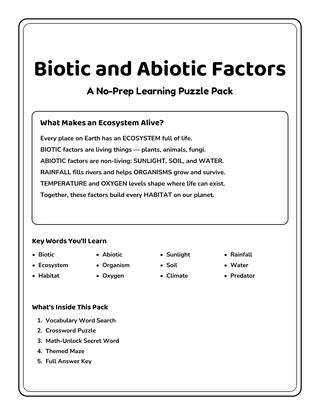
Biotic and Abiotic Factors
What Makes an Ecosystem Alive?
Every place on Earth has an ECOSYSTEM full of life. BIOTIC factors are living things – plants, animals, fungi. ABIOTIC factors are non-living: SUNLIGHT, SOIL, and WATER. RAINFALL fills rivers and helps ORGANISMS grow and survive. TEMPERATURE and OXYGEN levels shape where life can exist. Together, these factors build every HABITAT on our planet.
Key words: Biotic, Abiotic, Sunlight, Rainfall, Ecosystem, Organism, Soil, Water, Habitat, Oxygen, Climate, Predator.
Open the PDF (6 pages)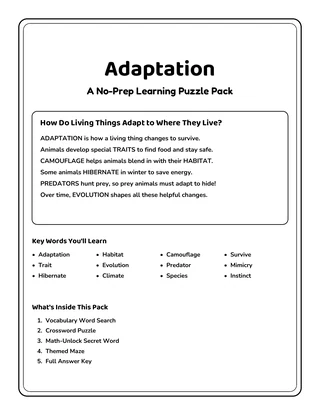
Adaptation
How Do Living Things Adapt to Where They Live?
ADAPTATION is how a living thing changes to survive. Animals develop special TRAITS to find food and stay safe. CAMOUFLAGE helps animals blend in with their HABITAT. Some animals HIBERNATE in winter to save energy. PREDATORS hunt prey, so prey animals must adapt to hide! Over time, EVOLUTION shapes all these helpful changes.
Key words: Adaptation, Habitat, Camouflage, Survive, Trait, Evolution, Predator, Mimicry, Hibernate, Climate, Species, Instinct.
Open the PDF (6 pages)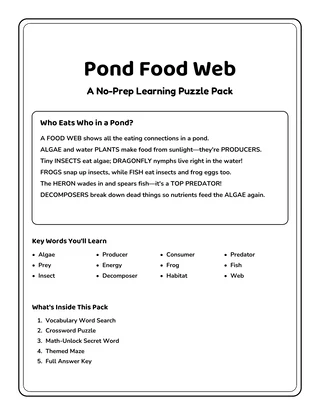
Pond Food Web
Who Eats Who in a Pond?
A FOOD WEB shows all the eating connections in a pond. ALGAE and water PLANTS make food from sunlight – they're PRODUCERS. Tiny INSECTS eat algae; DRAGONFLY nymphs live right in the water! FROGS snap up insects, while FISH eat insects and frog eggs too. The HERON wades in and spears fish – it's a TOP PREDATOR! DECOMPOSERS break down dead things so nutrients feed the ALGAE again.
Key words: Algae, Producer, Consumer, Predator, Prey, Energy, Frog, Fish, Insect, Decomposer, Habitat, Web.
Open the PDF (6 pages)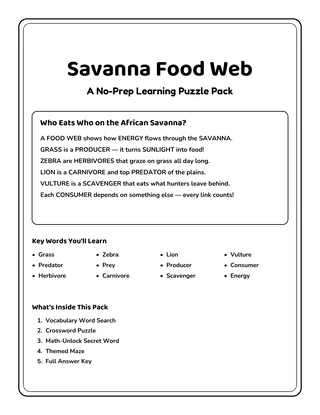
Savanna Food Web
Who Eats Who on the African Savanna?
A FOOD WEB shows how ENERGY flows through the SAVANNA. GRASS is a PRODUCER – it turns SUNLIGHT into food! ZEBRA are HERBIVORES that graze on grass all day long. LION is a CARNIVORE and top PREDATOR of the plains. VULTURE is a SCAVENGER that eats what hunters leave behind. Each CONSUMER depends on something else – every link counts!
Key words: Grass, Zebra, Lion, Vulture, Predator, Prey, Producer, Consumer, Herbivore, Carnivore, Scavenger, Energy.
Open the PDF (6 pages)Each lesson is shown as it is printed; the words in capitals are the vocabulary. Search the Cargo Bay for more packs like these.
Games on the same topic
Questions
- Are the packs really free to print?
- Yes. Every pack opens as a PDF with no account, no email and no card, for a class or at home.
- What is in a pack?
- Six letter-size pages in black and white: a one-page lesson, a word search, a crossword, a math code puzzle, a maze, and an answer key for the crossword and the code puzzle.
- What grades are they for?
- Grades 3 to 6, roughly ages 8 to 12. The lesson is a short paragraph, so most students can read it on their own.
- Who makes them?
- A small independent studio in Ontario, Canada. They are built with AI and checked before they go up.