Printables › Music and instruments
Music and instruments puzzle packs to print
10 free printable music and instruments puzzle packs for grades 3 to 6, as PDFs. No account, no card: open one and print it, for one student or a whole class.
- One-page lesson with key words
- Word search
- Crossword with clues
- Math code puzzle
- Maze
- Answer key for the crossword and the code
The four families of the orchestra first, then one pack per family. Musical notes and rhythm and beat are good sub plans for a music class.
The 10 packs
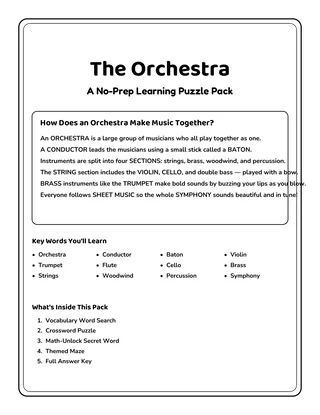
The Orchestra
How Does an Orchestra Make Music Together?
An ORCHESTRA is a large group of musicians who all play together as one. A CONDUCTOR leads the musicians using a small stick called a BATON. Instruments are split into four SECTIONS: strings, brass, woodwind, and percussion. The STRING section includes the VIOLIN, CELLO, and double bass – played with a bow. BRASS instruments like the TRUMPET make bold sounds by buzzing your lips as you blow. Everyone follows SHEET MUSIC so the whole SYMPHONY sounds beautiful and in tune!
Key words: Orchestra, Conductor, Baton, Violin, Trumpet, Flute, Cello, Brass, Strings, Woodwind, Percussion, Symphony.
Open the PDF (6 pages)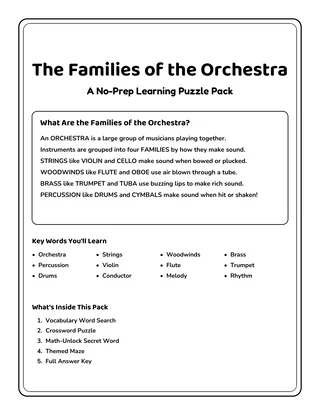
The Families of the Orchestra
What Are the Families of the Orchestra?
An ORCHESTRA is a large group of musicians playing together. Instruments are grouped into four FAMILIES by how they make sound. STRINGS like VIOLIN and CELLO make sound when bowed or plucked. WOODWINDS like FLUTE and OBOE use air blown through a tube. BRASS like TRUMPET and TUBA use buzzing lips to make rich sound. PERCUSSION like DRUMS and CYMBALS make sound when hit or shaken!
Key words: Orchestra, Strings, Woodwinds, Brass, Percussion, Violin, Flute, Trumpet, Drums, Conductor, Melody, Rhythm.
Open the PDF (6 pages)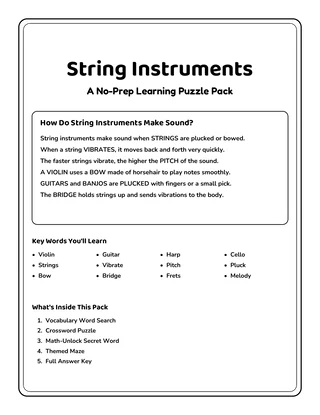
String Instruments
How Do String Instruments Make Sound?
String instruments make sound when STRINGS are plucked or bowed. When a string VIBRATES, it moves back and forth very quickly. The faster strings vibrate, the higher the PITCH of the sound. A VIOLIN uses a BOW made of horsehair to play notes smoothly. GUITARS and BANJOS are PLUCKED with fingers or a small pick. The BRIDGE holds strings up and sends vibrations to the body.
Key words: Violin, Guitar, Harp, Cello, Strings, Vibrate, Pitch, Pluck, Bow, Bridge, Frets, Melody.
Open the PDF (6 pages)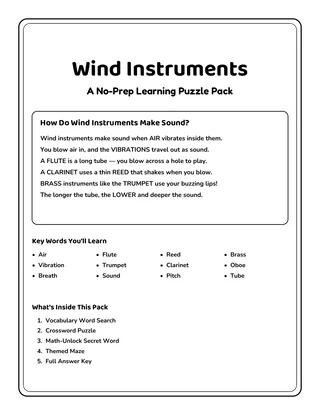
Wind Instruments
How Do Wind Instruments Make Sound?
Wind instruments make sound when AIR vibrates inside them. You blow air in, and the VIBRATIONS travel out as sound. A FLUTE is a long tube – you blow across a hole to play. A CLARINET uses a thin REED that shakes when you blow. BRASS instruments like the TRUMPET use your buzzing lips! The longer the tube, the LOWER and deeper the sound.
Key words: Air, Flute, Reed, Brass, Vibration, Trumpet, Clarinet, Oboe, Breath, Sound, Pitch, Tube.
Open the PDF (6 pages)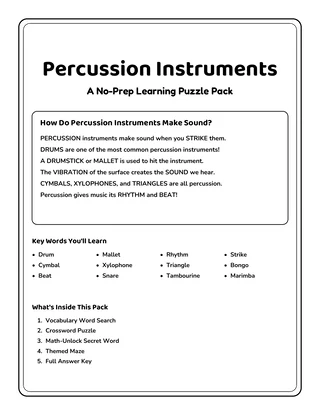
Percussion Instruments
How Do Percussion Instruments Make Sound?
PERCUSSION instruments make sound when you STRIKE them. DRUMS are one of the most common percussion instruments! A DRUMSTICK or MALLET is used to hit the instrument. The VIBRATION of the surface creates the SOUND we hear. CYMBALS, XYLOPHONES, and TRIANGLES are all percussion. Percussion gives music its RHYTHM and BEAT!
Key words: Drum, Mallet, Rhythm, Strike, Cymbal, Xylophone, Triangle, Bongo, Beat, Snare, Tambourine, Marimba.
Open the PDF (6 pages)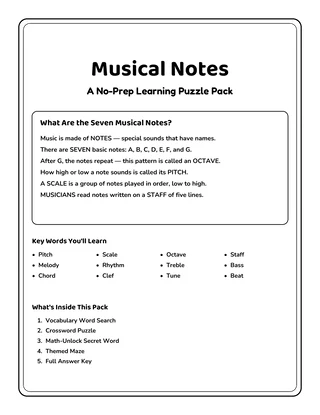
Musical Notes
What Are the Seven Musical Notes?
Music is made of NOTES – special sounds that have names. There are SEVEN basic notes: A, B, C, D, E, F, and G. After G, the notes repeat – this pattern is called an OCTAVE. How high or low a note sounds is called its PITCH. A SCALE is a group of notes played in order, low to high. MUSICIANS read notes written on a STAFF of five lines.
Key words: Pitch, Scale, Octave, Staff, Melody, Rhythm, Treble, Bass, Chord, Clef, Tune, Beat.
Open the PDF (6 pages)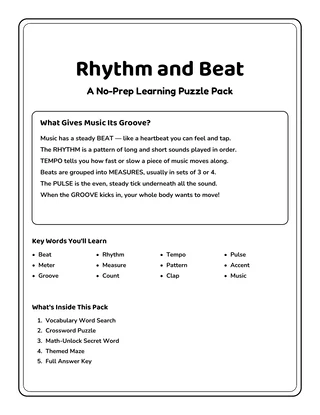
Rhythm and Beat
What Gives Music Its Groove?
Music has a steady BEAT – like a heartbeat you can feel and tap. The RHYTHM is a pattern of long and short sounds played in order. TEMPO tells you how fast or slow a piece of music moves along. Beats are grouped into MEASURES, usually in sets of 3 or 4. The PULSE is the even, steady tick underneath all the sound. When the GROOVE kicks in, your whole body wants to move!
Key words: Beat, Rhythm, Tempo, Pulse, Meter, Measure, Pattern, Accent, Groove, Count, Clap, Music.
Open the PDF (6 pages)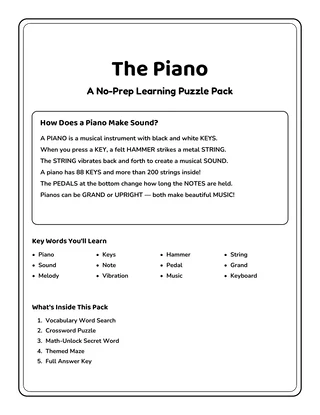
The Piano
How Does a Piano Make Sound?
A PIANO is a musical instrument with black and white KEYS. When you press a KEY, a felt HAMMER strikes a metal STRING. The STRING vibrates back and forth to create a musical SOUND. A piano has 88 KEYS and more than 200 strings inside! The PEDALS at the bottom change how long the NOTES are held. Pianos can be GRAND or UPRIGHT – both make beautiful MUSIC!
Key words: Piano, Keys, Hammer, String, Sound, Note, Pedal, Grand, Melody, Vibration, Music, Keyboard.
Open the PDF (6 pages)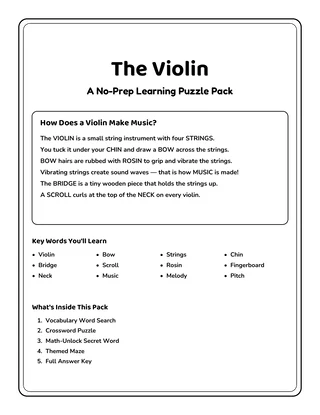
The Violin
How Does a Violin Make Music?
The VIOLIN is a small string instrument with four STRINGS. You tuck it under your CHIN and draw a BOW across the strings. BOW hairs are rubbed with ROSIN to grip and vibrate the strings. Vibrating strings create sound waves – that is how MUSIC is made! The BRIDGE is a tiny wooden piece that holds the strings up. A SCROLL curls at the top of the NECK on every violin.
Key words: Violin, Bow, Strings, Chin, Bridge, Scroll, Rosin, Fingerboard, Neck, Music, Melody, Pitch.
Open the PDF (6 pages)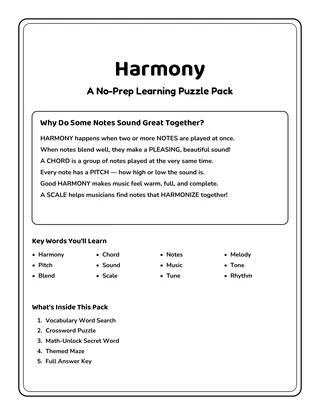
Harmony
Why Do Some Notes Sound Great Together?
HARMONY happens when two or more NOTES are played at once. When notes blend well, they make a PLEASING, beautiful sound! A CHORD is a group of notes played at the very same time. Every note has a PITCH – how high or low the sound is. Good HARMONY makes music feel warm, full, and complete. A SCALE helps musicians find notes that HARMONIZE together!
Key words: Harmony, Chord, Notes, Melody, Pitch, Sound, Music, Tone, Blend, Scale, Tune, Rhythm.
Open the PDF (6 pages)Each lesson is shown as it is printed; the words in capitals are the vocabulary. Search the Cargo Bay for more packs like these.
Games on the same topic
- Instrument OrbitInstruments game, free
- Staff StationReading Notes game, free
- Rhythm RocketNote Values game, free
- Tempo TrackerBeats Per Minute game, free
Questions
- Are the packs really free to print?
- Yes. Every pack opens as a PDF with no account, no email and no card, for a class or at home.
- What is in a pack?
- Six letter-size pages in black and white: a one-page lesson, a word search, a crossword, a math code puzzle, a maze, and an answer key for the crossword and the code puzzle.
- What grades are they for?
- Grades 3 to 6, roughly ages 8 to 12. The lesson is a short paragraph, so most students can read it on their own.
- Who makes them?
- A small independent studio in Ontario, Canada. They are built with AI and checked before they go up.