Printables › Rock and mineral
Rock and mineral puzzle packs to print
9 free printable rock and mineral puzzle packs for grades 3 to 6, as PDFs. No account, no card: open one and print it, for one student or a whole class.
- One-page lesson with key words
- Word search
- Crossword with clues
- Math code puzzle
- Maze
- Answer key for the crossword and the code
Start with the rock cycle, then igneous, sedimentary and metamorphic. Everyday minerals is the one that gets used at home: toothpaste, pencils, glass.
The 9 packs
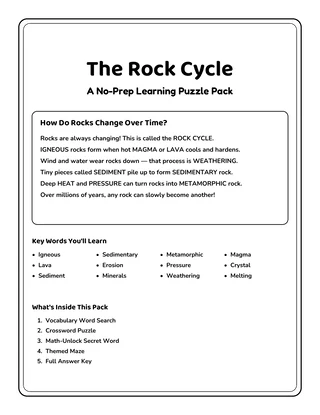
The Rock Cycle
How Do Rocks Change Over Time?
Rocks are always changing! This is called the ROCK CYCLE. IGNEOUS rocks form when hot MAGMA or LAVA cools and hardens. Wind and water wear rocks down – that process is WEATHERING. Tiny pieces called SEDIMENT pile up to form SEDIMENTARY rock. Deep HEAT and PRESSURE can turn rocks into METAMORPHIC rock. Over millions of years, any rock can slowly become another!
Key words: Igneous, Sedimentary, Metamorphic, Magma, Lava, Erosion, Pressure, Crystal, Sediment, Minerals, Weathering, Melting.
Open the PDF (6 pages)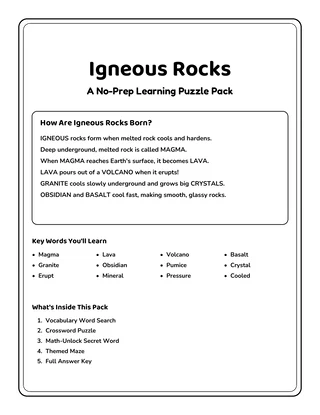
Igneous Rocks
How Are Igneous Rocks Born?
IGNEOUS rocks form when melted rock cools and hardens. Deep underground, melted rock is called MAGMA. When MAGMA reaches Earth's surface, it becomes LAVA. LAVA pours out of a VOLCANO when it erupts! GRANITE cools slowly underground and grows big CRYSTALS. OBSIDIAN and BASALT cool fast, making smooth, glassy rocks.
Key words: Magma, Lava, Volcano, Basalt, Granite, Obsidian, Pumice, Crystal, Erupt, Mineral, Pressure, Cooled.
Open the PDF (6 pages)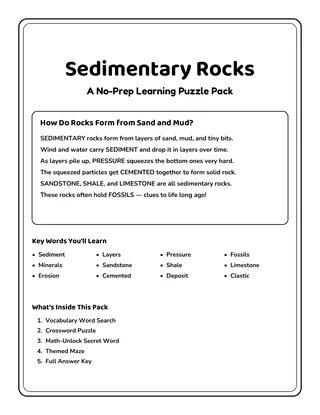
Sedimentary Rocks
How Do Rocks Form from Sand and Mud?
SEDIMENTARY rocks form from layers of sand, mud, and tiny bits. Wind and water carry SEDIMENT and drop it in layers over time. As layers pile up, PRESSURE squeezes the bottom ones very hard. The squeezed particles get CEMENTED together to form solid rock. SANDSTONE, SHALE, and LIMESTONE are all sedimentary rocks. These rocks often hold FOSSILS – clues to life long ago!
Key words: Sediment, Layers, Pressure, Fossils, Minerals, Sandstone, Shale, Limestone, Erosion, Cemented, Deposit, Clastic.
Open the PDF (6 pages)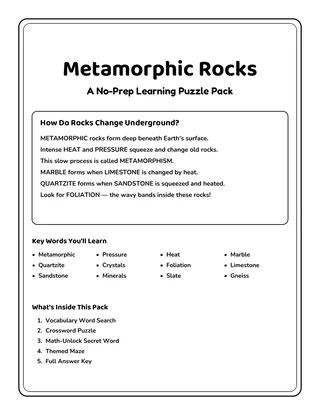
Metamorphic Rocks
How Do Rocks Change Underground?
METAMORPHIC rocks form deep beneath Earth's surface. Intense HEAT and PRESSURE squeeze and change old rocks. This slow process is called METAMORPHISM. MARBLE forms when LIMESTONE is changed by heat. QUARTZITE forms when SANDSTONE is squeezed and heated. Look for FOLIATION – the wavy bands inside these rocks!
Key words: Metamorphic, Pressure, Heat, Marble, Quartzite, Crystals, Foliation, Limestone, Sandstone, Minerals, Slate, Gneiss.
Open the PDF (6 pages)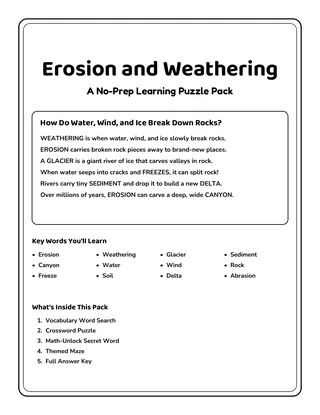
Erosion and Weathering
How Do Water, Wind, and Ice Break Down Rocks?
WEATHERING is when water, wind, and ice slowly break rocks. EROSION carries broken rock pieces away to brand-new places. A GLACIER is a giant river of ice that carves valleys in rock. When water seeps into cracks and FREEZES, it can split rock! Rivers carry tiny SEDIMENT and drop it to build a new DELTA. Over millions of years, EROSION can carve a deep, wide CANYON.
Key words: Erosion, Weathering, Glacier, Sediment, Canyon, Water, Wind, Rock, Freeze, Soil, Delta, Abrasion.
Open the PDF (6 pages)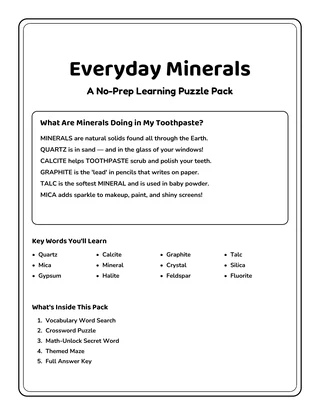
Everyday Minerals
What Are Minerals Doing in My Toothpaste?
MINERALS are natural solids found all through the Earth. QUARTZ is in sand – and in the glass of your windows! CALCITE helps TOOTHPASTE scrub and polish your teeth. GRAPHITE is the 'lead' in pencils that writes on paper. TALC is the softest MINERAL and is used in baby powder. MICA adds sparkle to makeup, paint, and shiny screens!
Key words: Quartz, Calcite, Graphite, Talc, Mica, Mineral, Crystal, Silica, Gypsum, Halite, Feldspar, Fluorite.
Open the PDF (6 pages)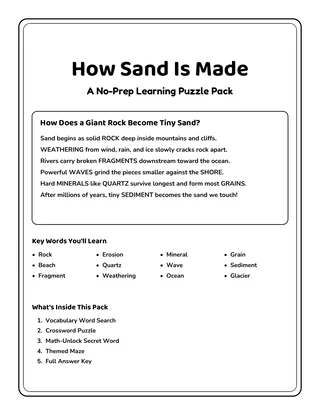
How Sand Is Made
How Does a Giant Rock Become Tiny Sand?
Sand begins as solid ROCK deep inside mountains and cliffs. WEATHERING from wind, rain, and ice slowly cracks rock apart. Rivers carry broken FRAGMENTS downstream toward the ocean. Powerful WAVES grind the pieces smaller against the SHORE. Hard MINERALS like QUARTZ survive longest and form most GRAINS. After millions of years, tiny SEDIMENT becomes the sand we touch!
Key words: Rock, Erosion, Mineral, Grain, Beach, Quartz, Wave, Sediment, Fragment, Weathering, Ocean, Glacier.
Open the PDF (6 pages)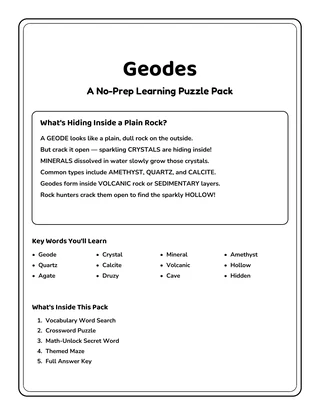
Geodes
What's Hiding Inside a Plain Rock?
A GEODE looks like a plain, dull rock on the outside. But crack it open – sparkling CRYSTALS are hiding inside! MINERALS dissolved in water slowly grow those crystals. Common types include AMETHYST, QUARTZ, and CALCITE. Geodes form inside VOLCANIC rock or SEDIMENTARY layers. Rock hunters crack them open to find the sparkly HOLLOW!
Key words: Geode, Crystal, Mineral, Amethyst, Quartz, Calcite, Volcanic, Hollow, Agate, Druzy, Cave, Hidden.
Open the PDF (6 pages)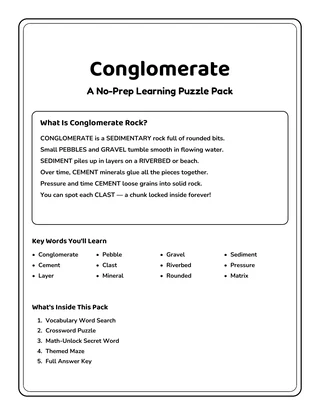
Conglomerate
What Is Conglomerate Rock?
CONGLOMERATE is a SEDIMENTARY rock full of rounded bits. Small PEBBLES and GRAVEL tumble smooth in flowing water. SEDIMENT piles up in layers on a RIVERBED or beach. Over time, CEMENT minerals glue all the pieces together. Pressure and time CEMENT loose grains into solid rock. You can spot each CLAST – a chunk locked inside forever!
Key words: Conglomerate, Pebble, Gravel, Sediment, Cement, Clast, Riverbed, Pressure, Layer, Mineral, Rounded, Matrix.
Open the PDF (6 pages)Each lesson is shown as it is printed; the words in capitals are the vocabulary. Search the Cargo Bay for more packs like these.
Games on the same topic
Questions
- Are the packs really free to print?
- Yes. Every pack opens as a PDF with no account, no email and no card, for a class or at home.
- What is in a pack?
- Six letter-size pages in black and white: a one-page lesson, a word search, a crossword, a math code puzzle, a maze, and an answer key for the crossword and the code puzzle.
- What grades are they for?
- Grades 3 to 6, roughly ages 8 to 12. The lesson is a short paragraph, so most students can read it on their own.
- Who makes them?
- A small independent studio in Ontario, Canada. They are built with AI and checked before they go up.