Printables › Fraction and decimal
Fraction and decimal puzzle packs to print
9 free printable fraction and decimal puzzle packs for grades 3 to 6, as PDFs. No account, no card: open one and print it, for one student or a whole class.
- One-page lesson with key words
- Word search
- Crossword with clues
- Math code puzzle
- Maze
- Answer key for the crossword and the code
These are vocabulary packs: the lesson and the crossword teach numerator, denominator, equivalent and the rest. Pair them with a game for the number practice.
The 9 packs
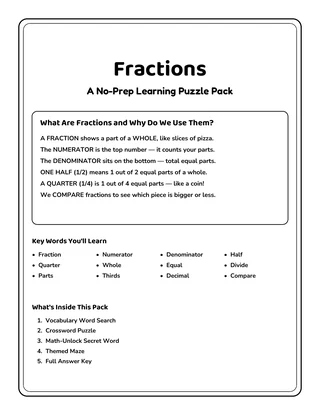
Fractions
What Are Fractions and Why Do We Use Them?
A FRACTION shows a part of a WHOLE, like slices of pizza. The NUMERATOR is the top number – it counts your parts. The DENOMINATOR sits on the bottom – total equal parts. ONE HALF (1/2) means 1 out of 2 equal parts of a whole. A QUARTER (1/4) is 1 out of 4 equal parts – like a coin! We COMPARE fractions to see which piece is bigger or less.
Key words: Fraction, Numerator, Denominator, Half, Quarter, Whole, Equal, Divide, Parts, Thirds, Decimal, Compare.
Open the PDF (6 pages)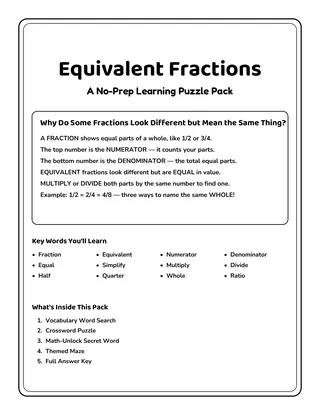
Equivalent Fractions
Why Do Some Fractions Look Different but Mean the Same Thing?
A FRACTION shows equal parts of a whole, like 1/2 or 3/4. The top number is the NUMERATOR – it counts your parts. The bottom number is the DENOMINATOR – the total equal parts. EQUIVALENT fractions look different but are EQUAL in value. MULTIPLY or DIVIDE both parts by the same number to find one. Example: 1/2 = 2/4 = 4/8 – three ways to name the same WHOLE!
Key words: Fraction, Equivalent, Numerator, Denominator, Equal, Simplify, Multiply, Divide, Half, Quarter, Whole, Ratio.
Open the PDF (6 pages)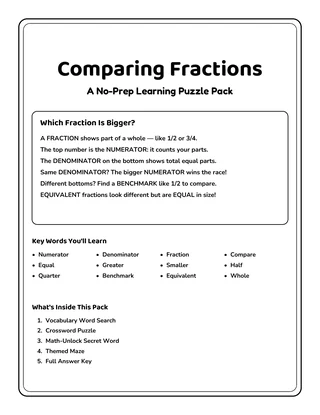
Comparing Fractions
Which Fraction Is Bigger?
A FRACTION shows part of a whole – like 1/2 or 3/4. The top number is the NUMERATOR: it counts your parts. The DENOMINATOR on the bottom shows total equal parts. Same DENOMINATOR? The bigger NUMERATOR wins the race! Different bottoms? Find a BENCHMARK like 1/2 to compare. EQUIVALENT fractions look different but are EQUAL in size!
Key words: Numerator, Denominator, Fraction, Compare, Equal, Greater, Smaller, Half, Quarter, Benchmark, Equivalent, Whole.
Open the PDF (6 pages)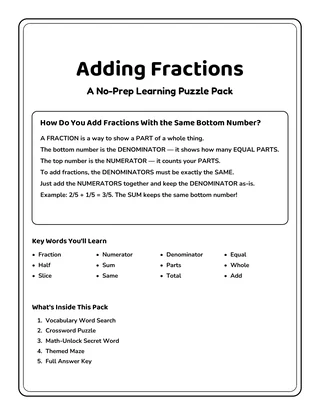
Adding Fractions
How Do You Add Fractions With the Same Bottom Number?
A FRACTION is a way to show a PART of a whole thing. The bottom number is the DENOMINATOR – it shows how many EQUAL PARTS. The top number is the NUMERATOR – it counts your PARTS. To add fractions, the DENOMINATORS must be exactly the SAME. Just add the NUMERATORS together and keep the DENOMINATOR as-is. Example: 2/5 + 1/5 = 3/5. The SUM keeps the same bottom number!
Key words: Fraction, Numerator, Denominator, Equal, Half, Sum, Parts, Whole, Slice, Same, Total, Add.
Open the PDF (6 pages)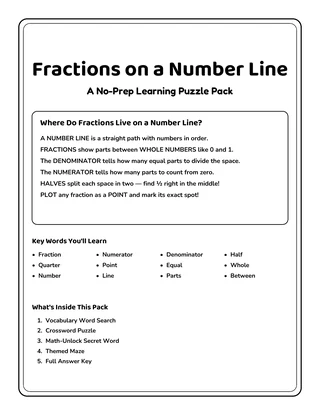
Fractions on a Number Line
Where Do Fractions Live on a Number Line?
A NUMBER LINE is a straight path with numbers in order. FRACTIONS show parts between WHOLE NUMBERS like 0 and 1. The DENOMINATOR tells how many equal parts to divide the space. The NUMERATOR tells how many parts to count from zero. HALVES split each space in two – find ½ right in the middle! PLOT any fraction as a POINT and mark its exact spot!
Key words: Fraction, Numerator, Denominator, Half, Quarter, Point, Equal, Whole, Number, Line, Parts, Between.
Open the PDF (6 pages)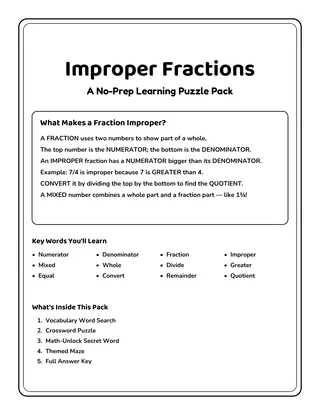
Improper Fractions
What Makes a Fraction Improper?
A FRACTION uses two numbers to show part of a whole. The top number is the NUMERATOR; the bottom is the DENOMINATOR. An IMPROPER fraction has a NUMERATOR bigger than its DENOMINATOR. Example: 7/4 is improper because 7 is GREATER than 4. CONVERT it by dividing the top by the bottom to find the QUOTIENT. A MIXED number combines a whole part and a fraction part – like 1¾!
Key words: Numerator, Denominator, Fraction, Improper, Mixed, Whole, Divide, Greater, Equal, Convert, Remainder, Quotient.
Open the PDF (6 pages)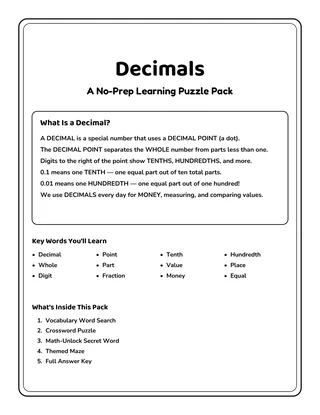
Decimals
What Is a Decimal?
A DECIMAL is a special number that uses a DECIMAL POINT (a dot). The DECIMAL POINT separates the WHOLE number from parts less than one. Digits to the right of the point show TENTHS, HUNDREDTHS, and more. 0.1 means one TENTH – one equal part out of ten total parts. 0.01 means one HUNDREDTH – one equal part out of one hundred! We use DECIMALS every day for MONEY, measuring, and comparing values.
Key words: Decimal, Point, Tenth, Hundredth, Whole, Part, Value, Place, Digit, Fraction, Money, Equal.
Open the PDF (6 pages)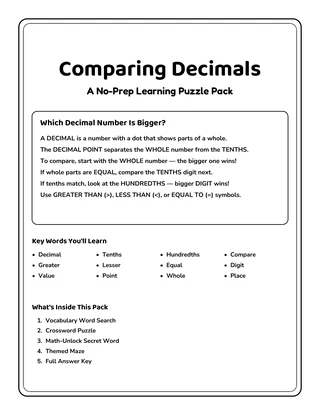
Comparing Decimals
Which Decimal Number Is Bigger?
A DECIMAL is a number with a dot that shows parts of a whole. The DECIMAL POINT separates the WHOLE number from the TENTHS. To compare, start with the WHOLE number – the bigger one wins! If whole parts are EQUAL, compare the TENTHS digit next. If tenths match, look at the HUNDREDTHS – bigger DIGIT wins! Use GREATER THAN (>), LESS THAN (<), or EQUAL TO (=) symbols.
Key words: Decimal, Tenths, Hundredths, Compare, Greater, Lesser, Equal, Digit, Value, Point, Whole, Place.
Open the PDF (6 pages)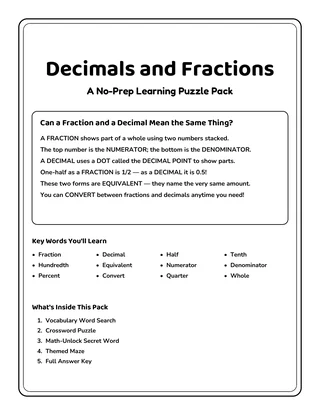
Decimals and Fractions
Can a Fraction and a Decimal Mean the Same Thing?
A FRACTION shows part of a whole using two numbers stacked. The top number is the NUMERATOR; the bottom is the DENOMINATOR. A DECIMAL uses a DOT called the DECIMAL POINT to show parts. One-half as a FRACTION is 1/2 – as a DECIMAL it is 0.5! These two forms are EQUIVALENT – they name the very same amount. You can CONVERT between fractions and decimals anytime you need!
Key words: Fraction, Decimal, Half, Tenth, Hundredth, Equivalent, Numerator, Denominator, Percent, Convert, Quarter, Whole.
Open the PDF (6 pages)Each lesson is shown as it is printed; the words in capitals are the vocabulary. Search the Cargo Bay for more packs like these.
Games on the same topic
- Fraction ForgeFractions game, free
- Decimal DockDecimals game, free
- Percent PulsePercentages game, free
- Fractions game by skillOne-click class links, free
Questions
- Are the packs really free to print?
- Yes. Every pack opens as a PDF with no account, no email and no card, for a class or at home.
- What is in a pack?
- Six letter-size pages in black and white: a one-page lesson, a word search, a crossword, a math code puzzle, a maze, and an answer key for the crossword and the code puzzle.
- What grades are they for?
- Grades 3 to 6, roughly ages 8 to 12. The lesson is a short paragraph, so most students can read it on their own.
- Who makes them?
- A small independent studio in Ontario, Canada. They are built with AI and checked before they go up.