Grammar Game: Find the Broken Word, One Skill at a Time
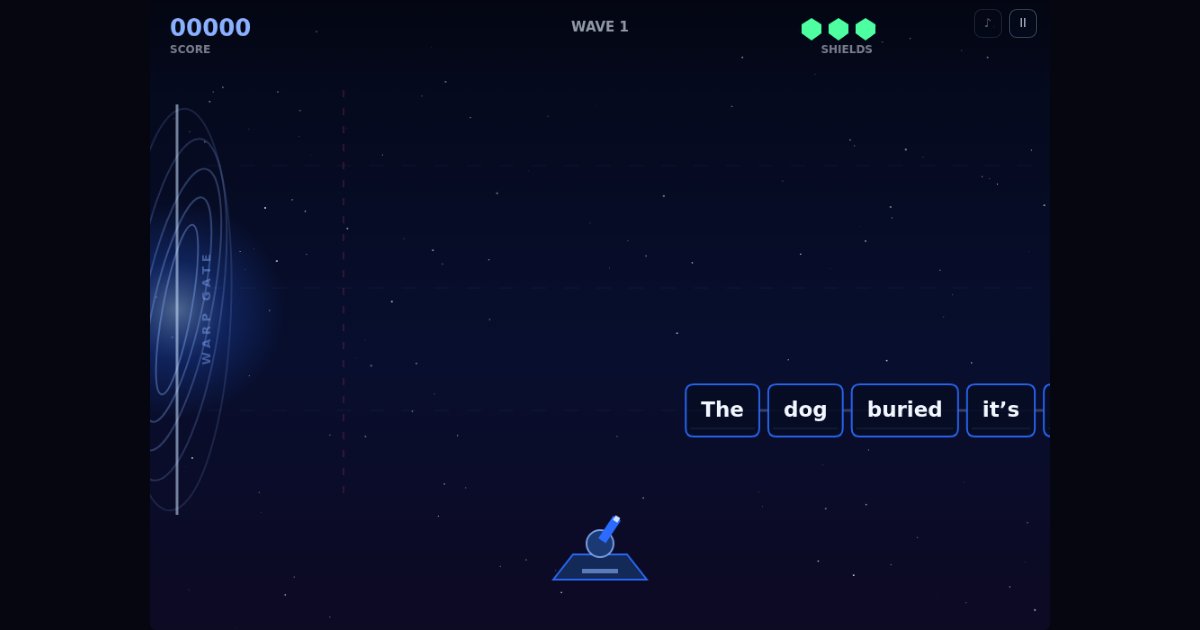
Grammar Blaster is a free grammar game for grades 3-6, played in a web browser on a desktop or laptop, with no account, no sign-in and nothing to install. One click per lesson. Grammar Blaster flies a sentence across the screen as a row of word pods, and exactly one word is wrong: there for their, runned for ran, a lowercase monday, three mouses, a apple. The student clicks the broken word to blast it, the right word drops into place, and a rule card says why. Miss it and the game shows the repair (THERE → THEIR) and brings that sentence back a few sentences later.
Pick a lesson, press play
Homophones
their / there / they're, your / you're, its / it's, to / too / two, then / than and hear / here. The pod shows the wrong one of the pair; the student blasts it and the right word drops in.
19 sentences
Verb tense
Irregular past tense (went, ran), adding -ed (the y to i and double-consonant rules) and the past participle after have or has (written, taken).
16 sentences
Subject-verb agreement
One thing does, many things do: the dog barks, the dogs bark. The broken pod is the verb that does not match its subject.
17 sentences
Capital letters
Names of people and places, the first word of a sentence, days and months (not seasons) and the word I.
18 sentences
Plurals
Irregular plurals (mice, children), adding -es after s, x, z, ch and sh, consonant-y to -ies, and f or fe to -ves.
17 sentences
A or an
An before a vowel SOUND, not a vowel letter: an hour, an honest pilot, but a uniform and a useful tip.
17 sentences
Verbs: tense and agreement
Both verb skills in one round, the game's own Verbs set. Good after a lesson on each.
33 sentences
Sentence basics
Capitals, plurals and a / an together, the game's own Sentence Basics set.
52 sentences
The rules the game teaches
After every repair a rule card shows the rule behind it for a few seconds (Rule Cards are on unless a teacher turns them off in Teacher Setup). These are the game's own words.
Homophones
their / there / they're: Their = belongs to them. There = a place. They're = they are.
your / you're: Your = belongs to you. You're = you are.
its / it's: It's = it is. Its, with no apostrophe, means belongs to it.
to / too / two: Too means also or very. Two is the number. To is everything else.
then / than: Than compares two things. Then tells you when.
hear / here: You hear with your ear. Here is a place.
Verb Tense
irregular past tense: Some verbs change shape in the past: go > went, run > ran.
past tense: add -ed: Adding -ed? Change a final y to i, and double a final consonant.
past participle: After have or has, use written and taken — not wrote or took.
Subject-Verb
subject–verb agreement: One thing does. Many things do. Match the verb to the subject.
Capital Letters
capitals: proper nouns: Names of people and places always start with a capital letter.
capitals: sentence start: Every sentence begins with a capital letter.
capitals: days and months: Days and months get capitals. Seasons do not.
capitals: the word I: The word I is always a capital, anywhere in the sentence.
Plurals
irregular plurals: Some plurals change the whole word: mouse > mice, child > children.
plurals: add -es: After s, x, z, ch or sh, add -es to make it plural.
plurals: -y to -ies: Consonant then y? Change the y to i and add -es.
plurals: -f to -ves: Many words ending in f or fe change to -ves.
A / An
a / an: Use an before a vowel SOUND: an hour, but a uniform.
Your own mix, one link for the class
The link opens Grammar Blaster with just that mix. Saved settings on a student's computer are left alone.
More free games
Every game on the Arcade Deck is free, with no account.
- Word WarpSpelling: the word flashes on the warp gate, then type it from memory.
- Meteor MathTimes tables: type the answer before the meteor lands.
- Star ChartsWorld geography: plot a course to the country, capital or landmark.
- Cell DiveCell biology: steer into the organelle that does the job named.
- Fraction FleetFractions: equivalent, compare, simplify, add and subtract.
- Memory CoreWorking memory: watch the pattern, then play it back.
See all 12 free games · Spelling list game · Dolch sight words game · Parts of a cell game · Times tables game
Questions teachers ask
- Is it free?
- Yes. Grammar Blaster is one of the 12 games on the Arcade Deck, which is free to play with no account and nothing to install. The ten rooms on the Promenade are for members; nothing on this page needs one.
- What do students need?
- A desktop or laptop computer with a mouse (click the broken word) or just the keyboard (the left and right arrows pick a word, Space fires), and an up-to-date browser.
- Which grammar is in it?
- Six error types and 104 sentences: Homophones (19), Verb Tense (16), Subject-Verb (17), Capital Letters (18), Plurals (17), A / An (17). Every sentence has exactly one broken word.
- What is not in it?
- No punctuation beyond capital letters (no commas, quotation marks or end marks, and no possessive apostrophes like the dog's), no labelling parts of speech, and no run-ons or fragments. The student finds and fixes one wrong word; they do not write sentences. A lesson on any of those needs another activity.
- Lesson or quiz?
- Each lesson card has a "Practice" link, where a miss shows the repair and the rule and the sentence comes back later, and a "Quiz" link, where the repair is not shown: a wrong shot speeds the sentence up, and a broken sentence that reaches the gate costs one of three shields. The rule card after a correct blast shows in both.
- Can I pick the skills?
- Yes. Tick the error types and the sentence length in the picker above and you get one link that opens Grammar Blaster with that mix. The mix lives in the link itself; we do not store anything.
- What grade is it for?
- It is pitched at grades 3 to 6. Short sentences (four or five words) suit the younger end; the lesson links use every sentence, up to nine words.
- Does it go too fast?
- It opens on Rookie, the slowest speed, where a sentence stays on screen for about eight seconds and only one sentence flies at a time. Clearing a sentence early brings the next one early, so a quick reader sets their own pace. Teacher Setup in the game changes the speed.
- Does it give a report?
- Yes. At the end of a mission the game lists the skills to practise (for example "their / there / they're") and the report prints as a take-home practice sheet.
- Do students sign in, or does it collect anything?
- No sign-in and no student accounts. There are no ad trackers. See the privacy page for the details. Privacy.
- Who makes Starship Arcade?
- Starship Arcade is a small independent studio in Ontario. The games are built with AI and tested before they ship.