Periodic Table Game: Element Symbols, Atomic Numbers and Families
Atom Smash is a free periodic table game for grades 3-8, played in a web browser on a desktop or laptop, with no account, no sign-in and nothing to install. One click per lesson. Atom Smash opens a particle collider with only the elements you picked racing around the ring as nuclei, and the panel at the top asks for one: the symbol for sodium, the element with atomic number 8, any halogen, the element in table salt. The student aims the emitter and fires before the containment clock runs out. Miss one and the panel holds the fact (SODIUM — Na), then asks it again a few prompts later.
Pick a lesson and how many elements, press play
Element families
SMASH ANY HALOGEN: any nucleus in that family counts. On First 10 the families are alkali metals, alkaline earth metals, metalloids, nonmetals, halogens, noble gases; transition metals join on All 36.
Or a whole unit
First 20 elements
Hydrogen to calcium, both ways: name to symbol and symbol to name. The usual first list to memorise.
Play this setAtomic numbers, first 20
Which element has 11 protons? Hydrogen to calcium by atomic number only.
Play this setMetals, nonmetals and noble gases
All 36 elements by family: alkali and alkaline earth metals, transition metals, metalloids, nonmetals, halogens and noble gases.
Play this setEveryday compounds
Water, carbon dioxide, table salt, chalk, sand: smash the element that is in it.
Play this setEnd-of-unit quiz
Every question type on all 36 elements, with the answer NOT shown after a miss. A last-week-of-the-unit check.
Play this set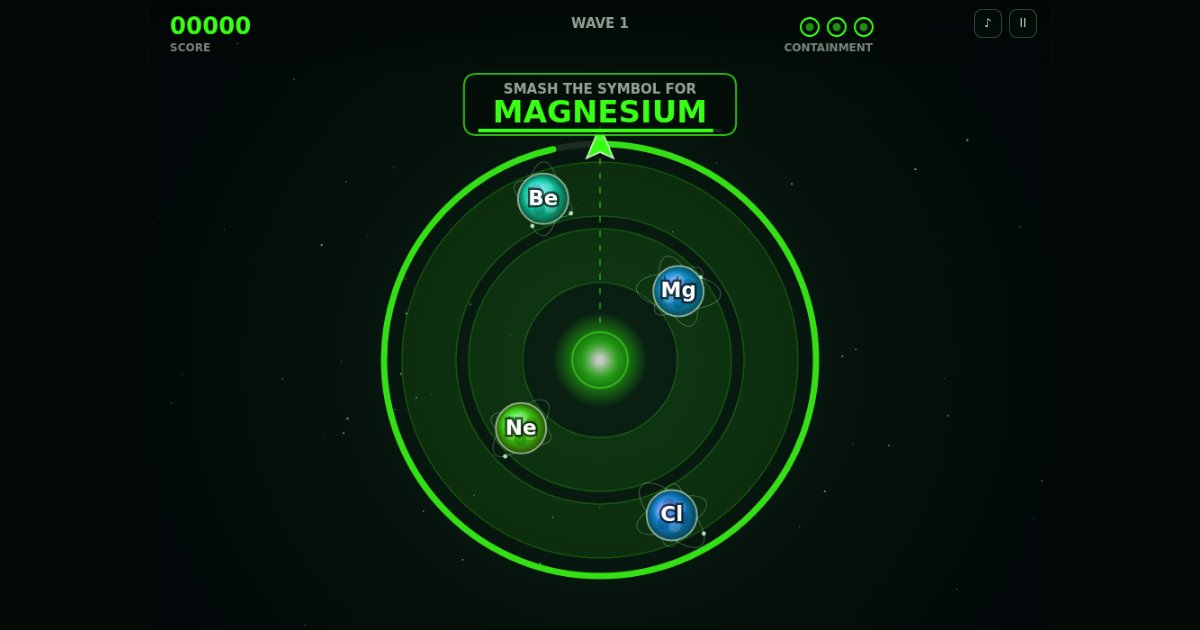
What is in each range
First 10 (H to Ne)
1 H Hydrogen, 2 He Helium, 3 Li Lithium, 4 Be Beryllium, 5 B Boron, 6 C Carbon, 7 N Nitrogen, 8 O Oxygen, 9 F Fluorine, 10 Ne Neon
Symbols both waysFirst 20 (H to Ca)
1 H Hydrogen, 2 He Helium, 3 Li Lithium, 4 Be Beryllium, 5 B Boron, 6 C Carbon, 7 N Nitrogen, 8 O Oxygen, 9 F Fluorine, 10 Ne Neon, 11 Na Sodium, 12 Mg Magnesium, 13 Al Aluminum, 14 Si Silicon, 15 P Phosphorus, 16 S Sulfur, 17 Cl Chlorine, 18 Ar Argon, 19 K Potassium, 20 Ca Calcium
Symbols both waysAll 36 (H to Kr)
1 H Hydrogen, 2 He Helium, 3 Li Lithium, 4 Be Beryllium, 5 B Boron, 6 C Carbon, 7 N Nitrogen, 8 O Oxygen, 9 F Fluorine, 10 Ne Neon, 11 Na Sodium, 12 Mg Magnesium, 13 Al Aluminum, 14 Si Silicon, 15 P Phosphorus, 16 S Sulfur, 17 Cl Chlorine, 18 Ar Argon, 19 K Potassium, 20 Ca Calcium, 21 Sc Scandium, 22 Ti Titanium, 23 V Vanadium, 24 Cr Chromium, 25 Mn Manganese, 26 Fe Iron, 27 Co Cobalt, 28 Ni Nickel, 29 Cu Copper, 30 Zn Zinc, 31 Ga Gallium, 32 Ge Germanium, 33 As Arsenic, 34 Se Selenium, 35 Br Bromine, 36 Kr Krypton
Symbols both waysYour own mix, one link for the class
The link opens Atom Smash with just that mix. Saved settings on a student's computer are left alone.
More free games
Every game on the Arcade Deck is free, with no account.
- Cell DiveCell biology: steer into the organelle that does the job named.
- Star ChartsWorld geography: plot a course to the country, capital or landmark.
- Meteor MathTimes tables: type the answer before the meteor lands.
- Word WarpSpelling: the word flashes on the warp gate, then type it from memory.
- Fraction FleetFractions: equivalent, compare, simplify, add and subtract.
- Code BreakerLogic: crack a secret shape code from the lock's clues.
See all 12 free games · Parts of a cell game · World map game · Fractions game · Times tables game · Spelling list game
Questions teachers ask
- Is it free?
- Yes. Atom Smash is one of the 12 games on the Arcade Deck, which is free to play with no account and nothing to install. The ten rooms on the Promenade are for members; nothing on this page needs one.
- What do students need?
- A desktop or laptop computer with a keyboard (left and right arrows aim, Space fires) or a mouse (click a nucleus to fire at it), and an up-to-date browser.
- Which elements are in it?
- The first 36, hydrogen (1) to krypton (36): the first four rows of the periodic table. There are no lanthanides, actinides or heavy metals like silver, gold or lead: it is a first-36 game, not an all-118 one. The three range cards above list every element in each one.
- Which families does it use?
- Alkali Metal, Alkaline Earth Metal, Transition Metal, Post-Transition Metal, Metalloid, Nonmetal, Halogen, Noble Gas. Hydrogen is filed as a nonmetal (it sits above the alkali metals but is not a metal). Germanium and arsenic are metalloids; selenium is a nonmetal. Transition metals first appear at scandium (21), so they only come up on All 36.
- Which compounds are in it?
- 16 that a grade 4-8 student has met: water (H2O), carbon dioxide (CO2), methane (CH4), ammonia (NH3), hydrogen peroxide (H2O2), table salt (NaCl), magnesium oxide (MgO), stomach acid (HCl), toothpaste fluoride (NaF), chalk (CaCO3), sand (SiO2), alumina (Al2O3), rust (Fe2O3), copper oxide (CuO), sunscreen (ZnO), salt substitute (KCl). A compound only comes up when every element in it is in play.
- Can I pick the elements and questions?
- Yes. Pick a range and tick the question types in the picker above and you get one link that opens Atom Smash with that mix. The mix lives in the link itself; we do not store anything.
- Does it go too fast for younger students?
- It opens on Rookie, the slowest speed, with a relaxed clock (four times the base time to answer). First 10 on Rookie is the grade-3 starting point. Teacher Setup in the game changes the speed and turns the after-a-miss answer on or off.
- Do students sign in, or does it collect anything?
- No sign-in and no student accounts. There are no ad trackers. See the privacy page for the details. Privacy.
- Who makes Starship Arcade?
- Starship Arcade is a small independent studio in Ontario. The games are built with AI and tested before they ship.